
Selecting a Human Capital Management (HCM) platform is one of the most consequential technology investments a company can make. The right platform acts as the central nervous system for your organization, seamlessly aligning talent management, benefits administration, and payroll into a single source of truth. Conversely, outgrowing your current system or choosing one that does not align with your operational maturity can lead to fragmented data, frustrated employees, and costly compliance errors.
When evaluating leading HR technology, the Workday vs ADP debate is one of the most common conversations among executive teams. Both are cloud-based, comprehensive solutions designed to streamline complex HR operations. However, they cater to fundamentally different organizational structures, sizes, and internal capabilities.
If you are weighing Workday against ADP Workforce Now, understanding the nuances of their capabilities and target audiences is critical to making the right strategic choice for your business.
The Core Philosophies: Unified Enterprise Suite vs. Comprehensive Mid-Market Ecosystem
To understand how these platforms compare, it helps to understand who they were built to serve and the core philosophies driving their architecture.
Workday is an established industry giant built specifically for the large enterprise space. It is consistently recognized as a Leader in the Gartner Magic Quadrant for Cloud HCM Suites for organizations with over 1,000 employees. Workday is built on a highly unified data model that integrates Human Capital Management with workforce management. It is designed for mid-size to large organizations, especially in the healthcare, retail, hospitality, higher education, government, and financial services sectors. While it aims for a quick implementation, it comes at the expense of a limited international footprint and less adoption in complex industries like manufacturing.
ADP Workforce Now takes a different approach, balancing robust capabilities with operational agility. It is specifically engineered as a comprehensive solution for mid-sized to large organizations, typically ranging from 50 to 5,000 employees. Leading analyst firms consistently recognize its dominance in this space, with Nucleus Research recently naming ADP Workforce Now a Leader in its SMB and Mid-Market HCM Value Matrix. ADP is built to provide enterprise-grade scale without the overwhelming administrative burden of an overly complex system. For organizations that need highly reliable, user-friendly functionality that scales effortlessly as they grow, ADP Workforce Now offers a much more agile and immediate environment.
Platform Comparison: A Deep Dive into Payroll and Compliance
While both systems offer comprehensive HR suites covering applicant tracking, onboarding, and performance management, payroll is almost always the deciding factor for organizations. Payroll is a high-stakes operation where accuracy and strict regulatory compliance are non-negotiable.
Here is how the payroll components of Workday and ADP Workforce Now compare:
Workday Payroll: Continuous Calculation and Global Reach
One of Workday’s standout features is its continuous payroll calculation engine. As HR, timekeeping, or compensation changes are entered throughout the pay period, the system recalculates net pay in real time. This eliminates the traditional processing bottlenecks that usually occur right before payday. Workday also excels for truly global organizations. Through its Global Payroll Cloud, multinational companies can integrate third-party, local-country payroll providers directly into Workday. This creates a unified global reporting dashboard, which is essential for managing complex international workforces and feeding precise labor costs directly into the corporate financial ledger.
ADP Workforce Now: Unrivaled Scale and Tax Compliance
When it comes to pure domestic reliability and tax compliance, ADP Workforce Now is largely unrivaled. ADP processes payroll for tens of millions of employees globally, and this massive scale ensures its infrastructure is tested against the most complex, high-volume scenarios imaginable. ADP recently earned the highest possible scores in 17 criteria within The Forrester Wave for Human Capital Management Solutions, heavily driven by its top-notch payroll and compliance features.
The platform features an exceptionally powerful tax engine that automatically updates federal, state, and local tax rates across all jurisdictions, removing a massive compliance burden from internal HR teams. Furthermore, ADP incorporates proactive, AI-powered anomaly detection that flags potential payroll errors before the run is finalized. This saves administrators from costly retroactive corrections and ensures employees are paid accurately the first time.
Integrations and Ecosystem Flexibility
A major differentiator between the two platforms is how they handle integrations with third-party software.
Workday operates as a tightly enclosed, highly unified system. The philosophy is that you should manage as much of your business as possible entirely within the Workday environment. While this ensures data consistency, it can become restrictive if your organization prefers to utilize specialized third-party software for specific functions like niche applicant tracking or specialized learning management.
ADP Workforce Now takes an open-ecosystem approach. The ADP Marketplace is an extensive digital storefront of pre-built API integrations. Because of ADP’s massive market share, nearly every leading third-party HR solution has a native integration built specifically for ADP Workforce Now. This allows HR leaders to easily adopt a “best-of-breed” strategy. You can maintain ADP as your core engine for payroll and foundational HR data while seamlessly plugging in your preferred specialized tools without incurring expensive custom development costs.
Data Analytics and The User Experience
In today’s highly competitive labor market, HR decisions must be driven by data, and both platforms offer distinct approaches to analytics.
Workday is known for its deep reporting capabilities. Because it ties HR data directly to corporate finance data, organizations can pull highly complex, cross-functional reports directly from the transactional engine. However, building and interpreting these customized reports often requires specialized training.
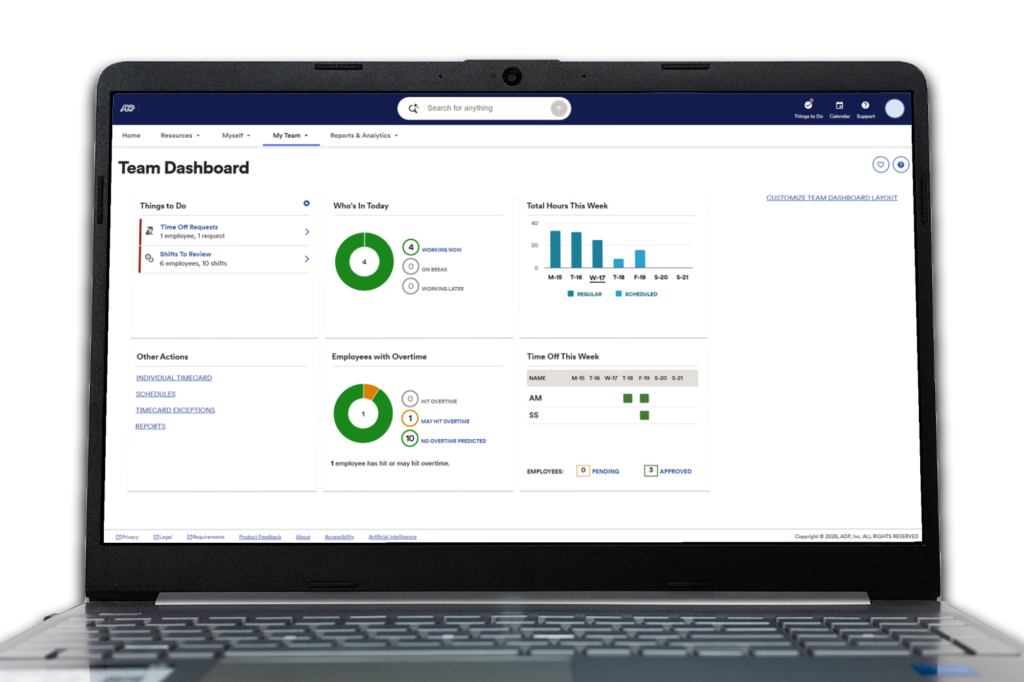
ADP Workforce Now counters this by offering highly actionable, out-of-the-box insights through ADP DataCloud. This feature taps into anonymized data from millions of employee records, allowing users to benchmark their compensation, turnover, and overtime metrics against similar companies in their exact industry and geographic region. Instead of relying on outdated external surveys, leaders get real-time benchmarking insights built directly into their daily workflows.
Additionally, both platforms prioritize the employee experience, but verified users on peer review sites like G2 frequently highlight ADP’s mobile app for its widespread employee adoption. By empowering employees with highly intuitive self-service tools to view pay stubs, manage benefits, and update direct deposits from their phones, HR departments significantly reduce their day-to-day administrative burdens.
Making the Decision: Which is Right for You?
Choosing between Workday and ADP Workforce Now ultimately comes down to your organization’s size, IT infrastructure, and operational complexity.
Choose Workday if you are a large enterprise (typically 2,500 to 5,000+ employees) with complex organizational hierarchies, deep global operations, and a strict need to unify your HR data directly with your corporate financial ledger. (Related: see how Workday compares to Paylocity.)
Choose ADP Workforce Now if you are a growing mid-market to large business (50 to 5,000 employees) that needs a scalable, user-friendly ecosystem. If engaging your employees with intuitive mobile tools, maintaining ultimate flexibility through third-party integrations, and securing the highest tier of multi-state payroll and tax compliance are your primary goals, ADP provides exceptional agility and immediate ROI. (Related: see how ADP Workforce Now compares to Dayforce.)
Maximize Your HCM Investment with Corban OneSource
Selecting your software is only the first step. Configuring the system, managing the daily data entry, and executing flawless HR and payroll processes day in and day out is where the real work begins. Migrating platforms is a significant undertaking, and navigating the day-to-day administration can quickly overwhelm an internal team. This is where an expert HR outsourcing (HRO) partner becomes invaluable.
At Corban OneSource, we are system-agnostic. We do not force our clients into a one-size-fits-all technology box. If you are currently evaluating your HCM platform options, our team of experts can help you make the right decision by analyzing your specific business needs, compliance requirements, and budget constraints.
More importantly, Corban OneSource can seamlessly step in to operate within your chosen platform. Whether you choose the enterprise analytics of Workday or the agile ecosystem of ADP Workforce Now, we can run your payroll, administer your benefits, and manage your multi-state HR compliance directly within your system. By letting Corban OneSource handle the heavy administrative lifting and HR technology maintenance behind the scenes, your internal HR team is freed up to focus on what truly matters: driving company culture, developing top talent, and executing strategic business growth.
Connect with us to learn more about HR Outsourcing!