
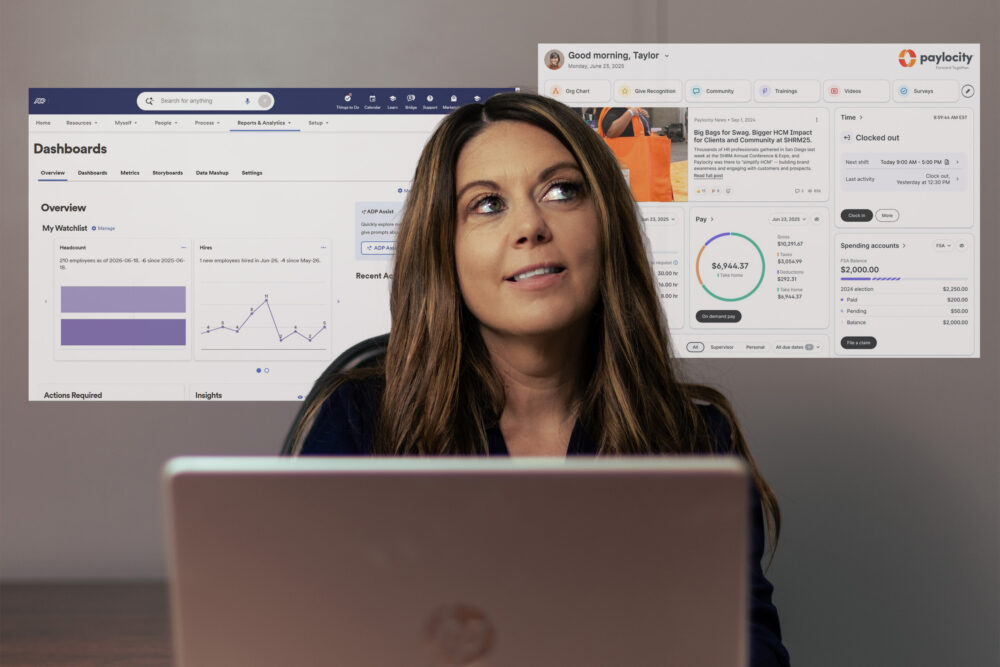
Businesses of all sizes need to track employees. Gone are the days of paper forms and written quarterly evaluations. Our ability to track our workforce digitally elevates the role of HR in the company.
HR departments no longer provide only an administrative service. There has long been an emphasis on recruiting and retaining top talent, but that has evolved from key points made in a boardroom to adopting strategies that are put into action. This has signified a cultural shift from the stereotype of the “paper pushers” in HR to achieving complex business objectives with strategic HR leadership.
To achieve these objectives, however, HR leaders need the appropriate tools. Systems have become much more sophisticated and continue to become better every day. Midsized businesses and larger greatly benefit from the use of an HCM platform. With so many options on the market, however, it is imperative to take time and evaluate which system will work best for your organization.
What is an HCM?
A Human Capital Management (HCM) System is an all-in-one software solution that allows a business to track workforce management. This includes many functions across HR, payroll, an employee’s lifecycle, and even gives a deeper dive with advanced reporting, analytics, and automation. It is used not only to manage talent, but it aids in compliance and forecasts data that executives can use for strategy building.
An HCM is a one source program that combines features found in many different HR systems, such as an HRIS or HRMS, and adds its own advanced functionality. The convenience of a single program creates a unified system and can offer more capabilities. You no longer need to worry about integrating different software systems and crossing your fingers that they will talk to each other.
Why do you need an HCM?
As your business grows, so do the demands of your workforce. Like the demands of your customers or clients, you need to be efficient and effective if you wish to recruit and retain top talent. This includes systems to support recruiting, onboarding, benefits, payroll, compliance, and performance management – all of which can be managed with the right HCM platform.
By elevating HR with the use of an HCM, your business is now equipped with more strategic advantages. An HCM will offer more data and analytics on manpower for business leaders to make key decisions. Automation will help not only complete administration tasks quicker but will ensure compliance. It will also include a self-service portal for your employees to check pay, benefits, and access other important documents.
Making the Right Choice. Evaluating HCM Platforms
The market for HCM platforms has become crowded. The systems also require extensive monetary, time, and manpower investments. It is imperative to ask many questions and evaluate many systems to find what will fit your business best.
What HCM System is Right for Your Business Size?
The first fundamental question you must answer when evaluating the right HCM is what is your current business size and how do you foresee your organizational growth? Implementation is a large, up-front investment. You want to evaluate how the platform will scale with your business for a minimum of five years into the future.
The availability of many options on the market means that each provider is likely to define their target audience, just as a regular business does. With this kind of market segmentation, it should be easy to eliminate multiple options from the start. Depending on your current employee count and projected growth, you can easily identify a few front-runners.
Small Business (SMB). Most small businesses lack the manpower or collateral to have an HR team, much less invest in strategic HR leadership. These organizations, however, still manage a workforce and have needs associated with human resources. Some small businesses focus only on task-oriented HR and therefore could reasonably invest in an HRIS to get everything done. Nonetheless, if you are growing and adding an HR leader, there are still HCM systems that serve this market best.
Mid-Market & Midsize Business. Somewhere between 50 – 100 employees, your priorities change, and strong HR leadership becomes much more valuable. The need to implement an HCM also becomes a critical task. At this level, HR leaders are struggling to keep their heads above water, so an HCM system provides additional efficiency for the department. HCM market leaders for mid-market and midsize businesses include ADP Workforce Now and Paylocity.
Enterprise Business. A larger workforce means larger demands, and your organization needs a system that keeps up. Enterprise businesses often have intricate organizational structures and need an HCM that can keep up with this complexity. HCM market leaders for enterprise businesses include platforms like Workday and UKG.
Small Business HCM
Paycor
Rippling
Midsize Business HCM
Paylocity
ADP Workforce Now
HiBob
Dayforce
Enterprise Business HCM
UKG
Workday
Oracle Fusion Cloud
SAP SuccessFactors
Stakeholders and Integration
While the HR leader and the HR team will be the primary managers of your new HCM system, there is a wide array of stakeholders to consider. The finance team will use it for payroll management and expense reporting. The CFO will oversee implementation expenses and costs of ongoing operation. Your company’s IT department will not only be highly engaged during implementation, but they will also ensure compatibility with existing software (outside of HR).
These are only a handful of voices to consider, but it highlights how this new HCM platform will be weaved into your existing operations. Evaluating the opinions of these stakeholders is crucial to successfully choosing the best option.
Multi-State and Global Workforce Capabilities
A staffing strategy that has proliferated in recent years is the use of remote workers. Whether this workforce is based in the United States or around the world, it has greatly enhanced the ability of hiring departments to recruit higher graded talent. This strategy has become so successful it is certainly becoming the norm, especially for midsize businesses that are rapidly scaling.
You need an HCM that has the capacity to implement workflows surrounding a remote workforce. This means different taxation tables at the state and local levels, federal regulations that set a floor preemption and allow states and localities to add standards, such as the Affordable Care Act (ACA) or Fair Labor Standards Act (FLSA), and state-issued worker’s compensation insurance, to name a few. An HCM that can help automate these tasks will set you steps ahead and help avoid frustrations.
Implementation
As mentioned above, your company’s IT department will be highly engaged throughout implementation. They will check compatibility, handle data migration, and enhance privacy and security. All top market HCM providers will have a specialized team to assist on their end, but the best systems will actively alleviate the burden from your company’s IT staff. Implementation timeframe is highly dependent on the size of your business, and it can take weeks or even months to launch.
Employee Self-Service
Employees (and people in general) want quick answers, and most people prefer to seek those answers independently and on their own time. Employees would rather avoid phoning the HR department as much as HR teams would like to avoid answering the phone and pulling attention away from projects they are working on. Top market HCM platforms include employee self-service modules where they can check pay statements, retrieve tax documents, update personal information, and more. Not only should you consider what self-service options are available, but also how intuitive the user interface is designed. The fewer emails the HR team receives, the better the system is for your employees.
Insights, Analytics, and Advanced Reporting
As stated in the introduction, an HCM is much more than a tool to complete HR tasks. The data you feed creates an entire ecosystem that can be analyzed and split into endless reports. These insights allow HR leaders to evaluate your human capital and make strategic decisions that advance your business’s goals. Whether it is recruitment, onboarding, retention, compensation, training, or any other abstract talent management strategy, a top market HCM will evaluate and produce advanced reports. This gives you the ability to identify and patch holes in your current strategy or employ new tactics to build new growth.
Customer Service – Administrative Support
Finally, what kind of customer service does the HCM company offer? With such a big system operating under your fingertips, there are bound to be technical issues. Is the help desk responsive? Do they make it easy to reach a representative? Additionally, you may want to consider if the provider offers administrative support, guidance, and training resources.
Choosing the Right HCM with a Managed Service Provider
Choosing the right HCM can be a daunting task. It takes a lot of time and effort to implement, transfer data, learn the system, and harness the power it offers HR leaders in strategy and decision-making. Partnering with the wrong system can set you back years. It behooves you to thoroughly analyze all options on the market, speak to many stakeholders about their opinions, and glean as much information from the providers as possible.
For midsize and mid-market businesses across the United States and Canada, finding an HR outsourcing partner that specializes in HCM management can alleviate much of this burden. A Managed Service Provider (MSP), in particular, has years of combined experience operating HCM platforms, and knows which system is best for your business.
An MSP, like Corban OneSource, can help you choose the right HCM, assist with implementation, execute routine HR tasks within the platform, and speak with tech support on your behalf. We even help you bundle pricing with our PEPM model, offering a price lock guarantee for life. We specialize in serving ADP Workforce Now and Paylocity clients. Find out more about HR technology services and reach out to us to see how we can help you choose the right HCM.
Connect with us to learn more about HR Outsourcing!