Selecting a Human Resources Information System (HRIS) is one of the most consequential technology investments a company can make. The right platform acts as the central nervous system for your organization, aligning talent management, benefits, and payroll into a single source of truth. Choose poorly, however, and you risk fragmented data, frustrated employees, and costly compliance errors.
When evaluating top-tier HRIS platforms, two names frequently dominate the conversation: Paylocity and Workday. Both are cloud-based, comprehensive solutions designed to streamline HR operations, but they cater to fundamentally different organizational needs, sizes, and operational complexities.
If you are weighing Paylocity against Workday, understanding the nuances of their HRIS capabilities is critical to making the right strategic choice.
The Core Philosophies: Agility vs. Enterprise Scale
To understand how these platforms compare, it helps to understand who they were built for.
Paylocity is widely recognized as a robust solution tailored for the mid-market. In fact, G2 consistently ranks Paylocity as a top Leader in Mid-Market Core HR, highlighting its user satisfaction and market presence. It is designed to be highly intuitive, agile, and relatively quick to implement. Paylocity excels at providing modern, employee-centric experiences, offering features like peer recognition, social collaboration hubs, and mobile-first accessibility that resonate well with today’s workforce. It is an ideal fit for growing companies that need robust functionality without the overwhelming complexity of an enterprise-level system.
Workday, on the other hand, is an established industry leader in the enterprise space. It has been recognized consecutively as a Leader in the Gartner Magic Quadrant for Cloud HCM Suites for 1,000+ Employee Enterprises. It is built on a unified data model that tightly integrates Human Capital Management (HCM) with financial management and enterprise planning. Workday thrives on complexity; it is designed for large, often multinational corporations with thousands of employees, intricate organizational structures, and deep data analytics needs. While its learning curve is steeper and implementation takes significantly longer, its scalability and depth of reporting are virtually unmatched.
Platform Comparison: A Deep Dive into Payroll
While both systems offer comprehensive HR suites covering applicant tracking, onboarding, and performance management, payroll is often the deciding factor for organizations. Payroll is a high-stakes operation where accuracy and compliance are non-negotiable. After all, research from the Workforce Institute at UKG reveals that nearly half (49%) of employees will begin looking for a new job after experiencing just two paycheck errors.
Here is how the payroll components of Paylocity and Workday compare:
Paylocity Payroll: Intuitive, Fast, and Employee-Centric
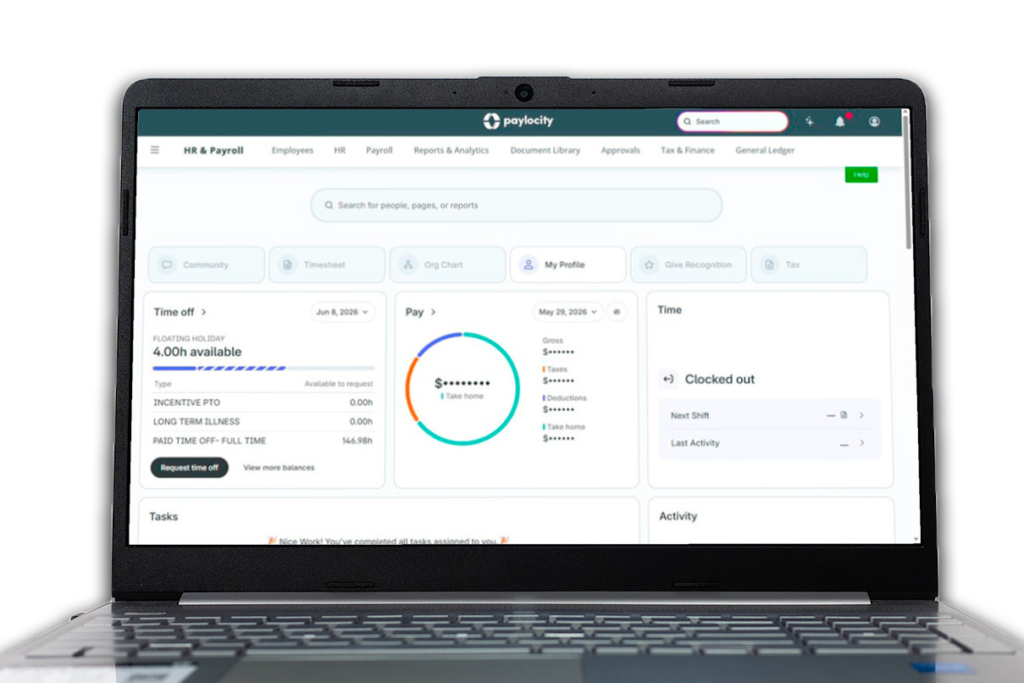
Paylocity’s payroll module is often praised for its clean interface and user-friendly processing workflows. It is built to take the headache out of domestic payroll for mid-sized organizations.
- Streamlined Processing: Paylocity offers an intuitive dashboard that flags potential errors, like missing timesheets or unusual overtime, before a payroll run is finalized, saving administrators from costly retroactive corrections.
- Tax Compliance: The system boasts an exceptionally strong built-in tax engine that automatically updates federal, state, and local tax rates, removing a massive compliance burden from internal HR teams.
- On-Demand Pay: Reflecting modern workforce trends, Paylocity offers native earned wage access (On-Demand Pay). With PwC’s Employee Financial Wellness Survey noting that 60% of full-time employees cite finances as their top source of stress, allowing employees to access a portion of their earned wages before traditional payday is a powerful retention tool that operates seamlessly within the payroll engine.
- Expense Management: Paylocity tightly integrates expense reporting directly into payroll, allowing for rapid reimbursement processing without the need for third-party software.
Workday Payroll: Complex Calculation and Global Reach
Workday’s payroll module is engineered for massive scale, complex compensation structures, and deep financial integration. It is built for organizations whose payroll requirements have outgrown standard mid-market solutions.
- Continuous Calculation: One of Workday’s standout features is its continuous payroll calculation. As HR or compensation changes are entered throughout the pay period (such as a mid-cycle promotion or a bonus), Workday recalculates payroll in real-time. This eliminates the massive processing bottlenecks that usually occur on “payroll Monday.”
- Global Payroll Cloud: While Workday offers native payroll for several major countries (including the US, UK, Canada, and France), its true strength lies in the Workday Global Payroll Cloud. This allows multinational companies to integrate third-party, local-country payroll providers directly into Workday, creating a unified global reporting dashboard that is essential for managing complex international compliance.
- Deep Financial Alignment: Because Workday is both an HCM and a Financial Management system, payroll data flows seamlessly into the general ledger. This provides finance teams with unparalleled, granular visibility into labor costs, overtime forecasting, and budget.
Making the Decision: Which is Right for You?
Choosing between Paylocity and Workday ultimately comes down to your organization’s size, growth trajectory, and operational complexity.
- Choose Paylocity if: You are a mid-market company (roughly 50 to 2,500 employees) looking for an intuitive, fast-to-implement system. If engaging your employees with modern, mobile-friendly tools and streamlining domestic payroll processing are your primary goals, Paylocity provides exceptional ROI. Related: see how Paylocity compares to Paychex for growing companies.
- Choose Workday if: You are a large or rapidly scaling enterprise (typically 2,500+ employees) with complex organizational hierarchies, global operations, and a need for deep integration between HR data and corporate finance. Related: see how Workday compares to ADP Workforce Now.
If you currently have one of these HCM systems in operation but no one manages it, read our guide to find the perfect HCM management fix.
Maximize Your HRIS Investment with Corban OneSource
Selecting the software is only the first step; configuring it, maintaining it, and executing flawless HR and payroll processes day in and day out is where the real work begins. This is where an expert HR outsourcing (HRO) partner becomes invaluable.
At Corban OneSource, we are system-agnostic. We don’t force our clients into a one-size-fits-all box. If you are currently evaluating your options, our team of experts can help you make the right decision by analyzing your specific business needs, compliance requirements, and budget to determine whether Paylocity, Workday, or another HRIS is your perfect match.
More importantly, we can partner with you on either system. Whether you prefer the agile, employee-centric features of Paylocity or the deep, enterprise-level analytics of Workday, Corban OneSource can seamlessly step in to run your payroll, administer your benefits, and manage your HR compliance directly within your chosen platform.
By letting Corban OneSource handle the heavy administrative lifting behind the scenes, your internal HR team is freed up to focus on what truly matters: driving company culture, developing talent, and leveraging your HRIS data for strategic business growth.
FAQ
Paylocity is primarily built to serve midsized companies, equipped with an intuitive, agile design, implementation is quick compared to market and has an employee-centric model. Workday is built for enterprise organizations (1,000+) and integrates HCM with financial management and enterprise planning. Its platform tends to be much more complex in order to serve larger employee bases.
Paylocity is built for efficiency. Its streamlined process helps catch errors while inputting payroll, and it automatically calculates tax updates on the federal, state, and local levels on a consistent basis. It also offers detailed expense reporting.
Workday is built for scale and includes features that large enterprise employers may find valuable. It offers continuous pay calculations to avoid bottlenecks and has a deeply integrated global payroll cloud – allowing international solutions to plug directly into Workday.
Corban OneSource prefers to work with ADP Workforce Now or Paylocity, as those two platforms provide the features and robust software that significantly enhances the experience for our primary client base. However, we do service clients on Workday if the technology is a better fit, and that company is scaling at a more rapid pace.
Connect with us to learn more about HR Outsourcing!